Assembly area
Torch front end
Function
Surrounds the electrode area and directs shielding gas toward the weld zone.
Buyer should confirm
Cup number, connection style, torch family and standard collet-body or gas-lens arrangement.
Technical Buyer Guide
A component-by-component reference for naming TIG torch parts, understanding their assembly positions and preparing evidence for compatibility review.
Component Reference
Use this assembly-based reference to name each item before comparing dimensions or model information. The component name and function help organize an inquiry; compatibility still requires evidence from the exact torch, drawing, approved reference or sample.
Assembly area
Torch front end
Function
Surrounds the electrode area and directs shielding gas toward the weld zone.
Buyer should confirm
Cup number, connection style, torch family and standard collet-body or gas-lens arrangement.
Assembly area
Inside the torch head
Function
Grips and centers the tungsten electrode when the back cap is tightened.
Buyer should confirm
Tungsten diameter, collet length, torch family and matching collet body or gas lens.
Assembly area
Inside the ceramic cup
Function
Supports the collet and forms part of the shielding-gas path through the torch head.
Buyer should confirm
Thread, overall form, tungsten diameter, torch family and ceramic cup arrangement.
Assembly area
Inside the ceramic cup
Function
Uses an internal screen arrangement to distribute shielding gas before it exits the cup.
Buyer should confirm
Gas-lens family, thread, tungsten bore, torch series and compatible cup arrangement.
Assembly area
Rear of the torch head
Function
Secures the collet system and accommodates the tungsten projecting through the torch head.
Buyer should confirm
Rear thread, cap length, torch family and available working clearance.
Assembly area
Centered through the torch head
Function
Carries the TIG welding arc as a non-consumable electrode in the approved welding setup.
Buyer should confirm
Documented diameter, length, type or color reference and the buyer's approved application requirement.
Assembly area
Front torch assembly
Function
Houses the front-end parts and connects them to the torch cable or hose assembly.
Buyer should confirm
Torch family, head form or angle, cooling configuration when documented and cable-side interface.
Assembly area
Handle and control area
Function
Provides a torch-mounted control input where the torch and welding machine arrangement supports it.
Buyer should confirm
Switch shape, mounting position, lead length and connector or wiring reference from the existing assembly.
Assembly area
Torch handle to machine
Function
Carries the services required by the documented torch configuration, which can include current, gas, coolant or control wiring.
Buyer should confirm
Required length, torch-side connection, machine-side connection and the exact service lines shown by the existing torch.
Assembly area
End of the cable assembly
Function
Connects the torch assembly to the compatible welding equipment interface.
Buyer should confirm
Connector body, power interface, gas fitting and any control pins from a drawing, sample or approved reference.
This reference explains product families and assembly roles. It does not confirm fit, dimensions, electrical ratings or interchangeability for a specific torch.
Technical Guidance
Use the article to identify the evidence needed for review. Confirm the exact supplied product separately through quotation, drawing, sample or approved reference.
Begin with the complete torch instead of one loose component. Record the front-end consumable stack, torch head and body, handle and control area, rear cap, cable or hose assembly, and machine-side connector. This zone-based view helps distinguish a ceramic cup from an internal collet part and a torch switch from a cable or connector item. Keep the original assembly intact until the complete torch and model label have been photographed.
The Renqiu Ailesen company catalog documents TIG torch and component structures for WP-9/WP-20, WP-17/WP-18/WP-26 and WP-27 series reference groups. These references can narrow an inquiry and show which component names belong in a parts list. They do not prove that every cup, collet, body, gas lens, back cap or cable termination is interchangeable. State the exact series shown on the torch and confirm the full arrangement by label, drawing, approved sample or repeat-order record.
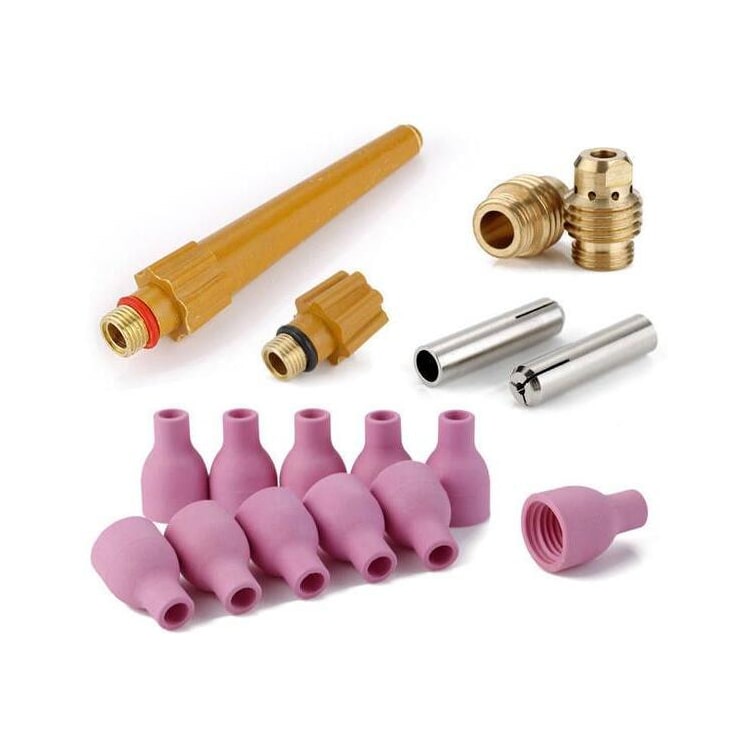
Name each requested item by its function before adding a model reference. Common front-end TIG welding torch components include the ceramic cup, collet, collet body, gas lens and tungsten electrode. The rear torch-head item is normally described as a back cap. Other service items can include the torch head or body, handle, torch switch, cable or hose assembly and machine-side connector. A descriptive part name is useful for communication, but it is not proof of compatibility.
Provide one photo of the complete torch, one of the model or label area, and clear front, side and connection views of every loose part. Place the removed front-end components in assembly order so the relationship between cup, body or gas lens, collet and tungsten remains visible. Include a ruler or scale where practical, but do not report a dimension as final unless the measurement method and reference points are clear.
Copy visible cup numbers, model labels, thread references, package labels and existing part numbers exactly as shown. Record tungsten diameter, component length, thread or connector details only from an approved drawing, catalog reference or measured sample. If a marking is incomplete, provide a close photograph and label the value as uncertain rather than completing it from memory or appearance.
Correctly naming a part does not confirm that it fits a particular torch. A #5 ceramic cup, 1.6 mm collet or gas lens description still needs the related torch series, connection and complete consumable arrangement. Use the identification record to narrow the review, then confirm compatibility by torch model, drawing, approved reference, complete stack or physical sample before ordering.
For a TIG torch switch, photograph the visible switch shape, mounting area, lead and connector or wiring reference without altering the assembly. For a complete torch, state whether the request covers the torch body only or includes the cable, hose, connector, switch and front-end consumables. Cable length, connection and machine interface should remain buyer-provided or document-based fields rather than estimates from a photograph.
Give every part its own line with a provisional name, quantity and evidence reference. Attach the complete-torch photo, label photo, disassembly-order image and any drawing or sample details. Mark which values are confirmed and which require supplier review. Add destination country, standard or OEM packaging request and whether the order is a trial or repeat requirement so product review and commercial quotation can proceed together.
Buyer Checklist
Prepare one traceable evidence set before asking a supplier to confirm the requested parts.
Buyer RFQ Tool
Complete only documented values, then attach the available photos, drawings or reference files for technical review.
Use the CSV worksheet to keep each requested product or variant on a separate quotation line.
Keep each requested item or variant on a separate line and leave unknown technical values open for confirmation.
Open the RFQ Product List Worksheet and keep each requested item or variant on a separate row.
Add quantity, available product references, packing needs and destination country.
Attach the completed file with product photos, drawings or reference documents in the RFQ form.
Product Research
Use category pages for range-level selection and product pages for the currently published item records.

TIG / Torch Parts
TIG / Torch Parts

TIG / Torch Parts

TIG / Torch Parts

TIG / Torch Parts


TIG / Torch Parts

TIG / Torch Parts
Continue Research
Continue with another guide that shares the same product or compatibility context.
One photo may suggest a part family, but reliable review normally needs the complete torch, model label, assembly order, connection views and a drawing or sample when available.
No. The cup number should be checked with the torch series, connection style and the standard collet-body or gas-lens arrangement.
Identification establishes what kind of part is being discussed. Compatibility confirms that its dimensions, interfaces and assembly match the required torch reference.
Send part names, quantities, complete-torch and label photos, components in assembly order, available measurements, drawing or sample references, packaging needs and destination country.
Request for Quotation
Send product names, photos, drawings, quantity, packaging requirements and destination country. ArcFort Weld will review confirmed details before quotation.